MAC-I2: Learned Metrics-Aware Covariance for Robust Visual-Inertial Fusion in Initialization and Calibration
* Equal Contribution
1 Robotics Institute, Carnegie Mellon University
2 MBZUAI
3 UTIAS, University of Toronto
Background: trajectories estimated during calibration
Ground TruthMAC-I2 Estimated
Abstract
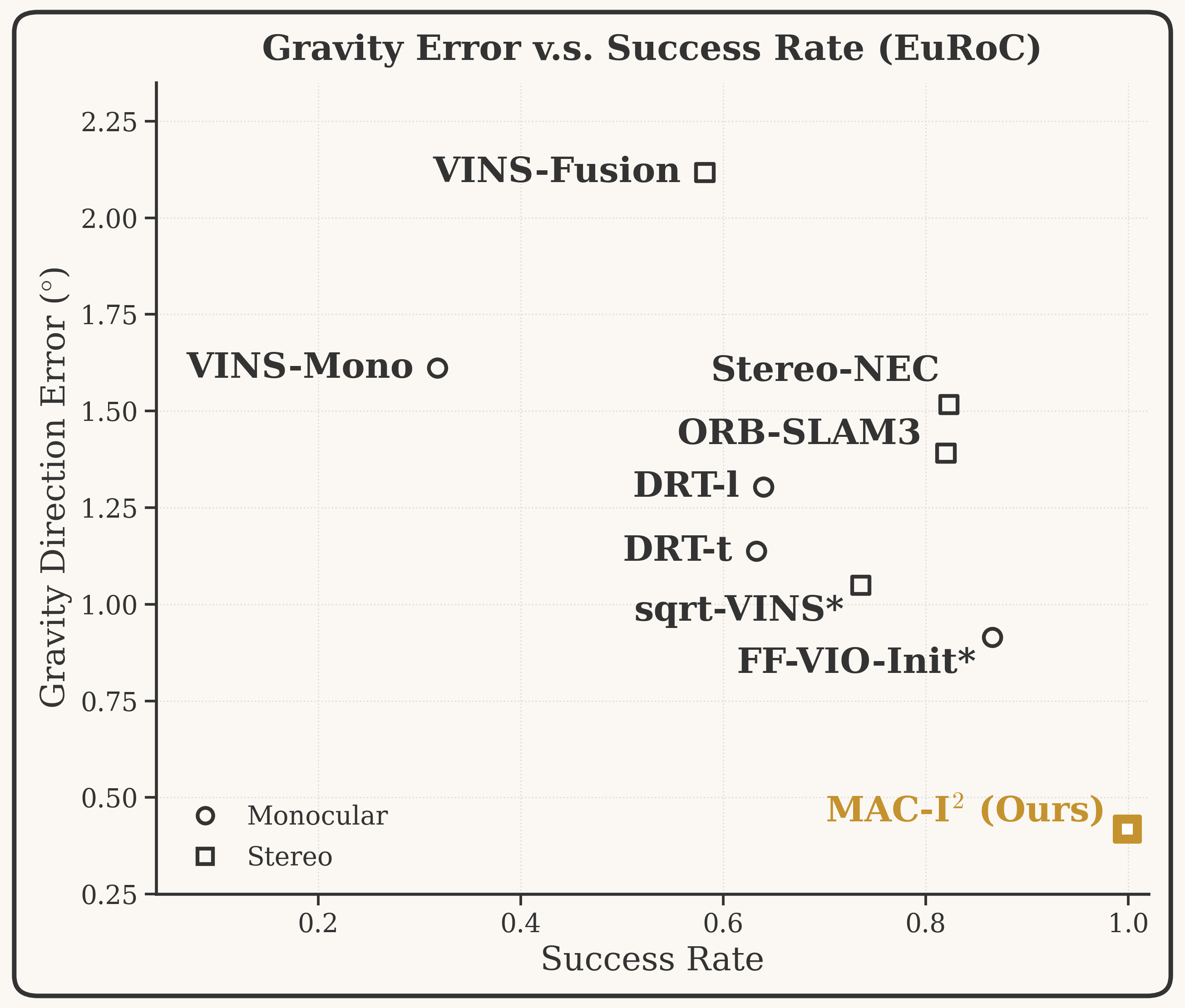
Visual-Inertial (VI) fusion is fundamental to accurate and robust state estimation, where camera and IMU measurements are combined according to their respective uncertainties. Existing methods, however, fuse the two modalities with predefined uncertainties, regardless of how reliable each is in the local context, and thus often struggle under challenging environments involving illumination changes, dynamic objects, and textureless regions. In this paper, we present MAC-I2, which achieves robust VI fusion through learned metrics-aware covariance for both modalities, so that vision and IMU compete on their own merits rather than relying on predefined uncertainties. Here, metrics-aware means that each predicted covariance faithfully reflects the actual magnitude of the corresponding measurement noise. On the visual side, we propagate learned feature-matching uncertainties into pose covariances for the fusion. On the inertial side, motivated by the observation that integration error accumulates sharply at the early stage and grows slowly afterward, we design a learned IMU model with a learnable initial covariance, and propose a dedicated fine-tuning strategy on a held-out training subset to enable the metrics-aware covariance on unseen sequences. As a showcase, we build a VI initialization and calibration system, since accurate and robust initialization and calibration are the prerequisite for any reliable VI system. Experiments on EuRoC and VBR show that MAC-I2 substantially outperforms existing methods: it achieves a 99.9% initialization success rate on EuRoC, reducing gravity and velocity errors by about 60% and 42% over the strongest baseline, and maintains an 80% success rate on challenging VBR sequences where baseline methods such as VINS-Mono drop below 10%.
Demonstrations
MAC-I2 stays reliable where predefined uncertainties fail. Explore its behavior across challenging environments and real-world deployments.
Illumination Change Extreme Exposure
Dynamic Scene Moving Objects
Dark Room Dark
Bottom-left shows the input images.
Calibration
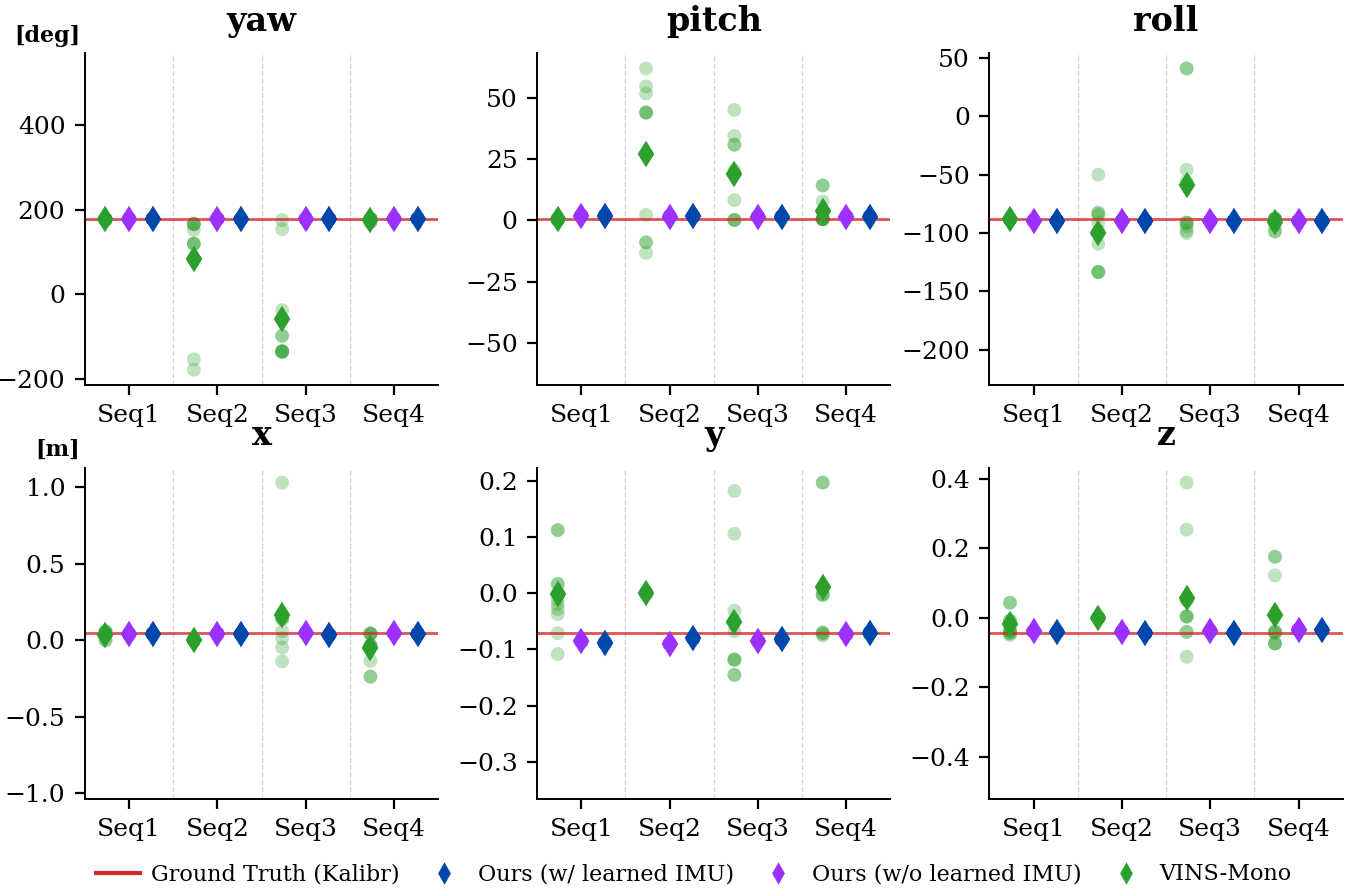
For each sequence we show the sensor input (left) and the estimated trajectory during calibration (right), played in sync.
Sequence 1
Estimated Trajectory during Calibration
Ground TruthMAC-I2 Estimated
Sequence 2
Estimated Trajectory during Calibration
Ground TruthMAC-I2 Estimated
Sequence 3
Estimated Trajectory during Calibration
Ground TruthMAC-I2 Estimated
Sequence 4
Estimated Trajectory during Calibration
Ground TruthMAC-I2 Estimated
Method
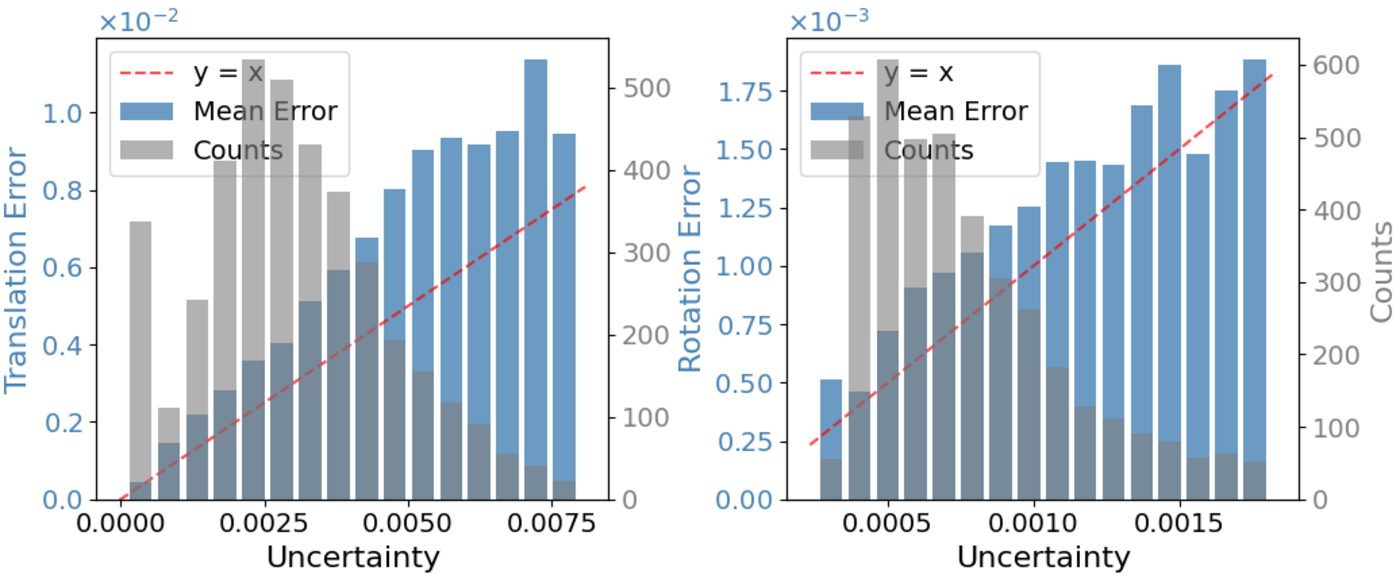
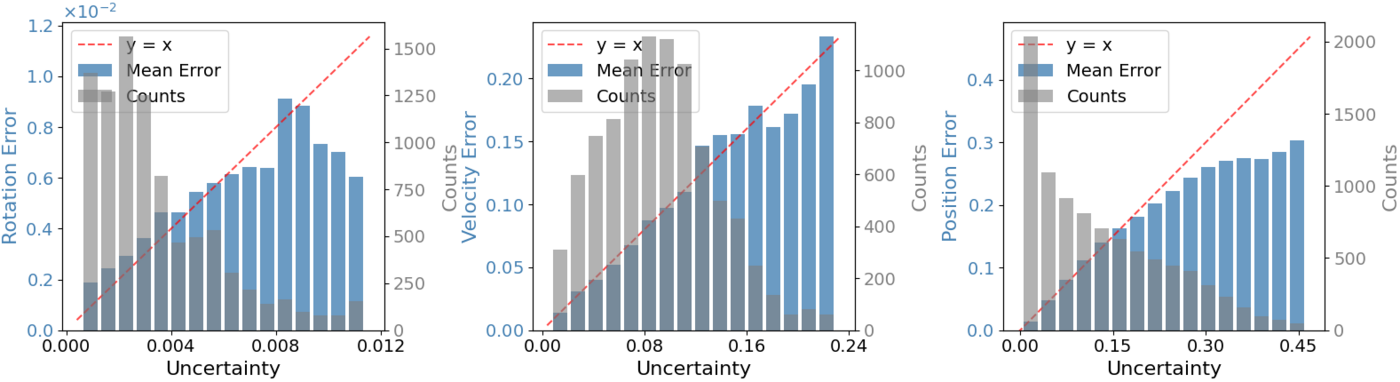
MAC-I2 learns metrics-aware covariance for both modalities, so that each measurement is weighted by its actual reliability in the local context rather than by a predefined rule.
Metrics-Aware Visual Covariance
On the visual side, we propagate the learned feature-matching uncertainties from MAC-VO into pose covariances through the information matrix at the convergence of the visual pose estimation, bringing metrics-aware visual uncertainty into the fusion.
Metrics-Aware Inertial Covariance
On the inertial side, the integration error accumulates sharply at the early stage of the integration window and grows slowly afterward. We design a learned IMU model with a learnable initial covariance to capture this pattern, together with a held-out fine-tuning strategy that keeps the predicted covariance metrics-aware on unseen sequences.
Quantitative Results
Citation
@misc{fei2026maci2learnedmetricsawarecovariance,
    title={MAC-I$^2$: Learned Metrics-Aware Covariance for Robust Visual-Inertial Fusion in Initialization and Calibration},
    author={Xiang Fei and Yuheng Qiu and Can Xu and Yutian Chen and Ruogu Li and Xingxing Zuo and Wenshan Wang and Sebastian Scherer},
    year={2026},
    eprint={2609.07116},
    archivePrefix={arXiv},
    primaryClass={cs.RO},
    url={https://arxiv.org/abs/2609.07116},
  }